---
You know him. Long ponytail. Oval glasses. Has been at the company longer than the version control. You show him fifty lines; he looks at them, says nothing, and replaces them with one.
Ponytail puts him inside your AI agent.
## Before / after
You ask for a date picker. Your agent installs flatpickr, writes a wrapper component, adds a stylesheet, and starts a discussion about timezones.
With ponytail:
```html
```
More survivors in [examples/](examples/).
## Numbers
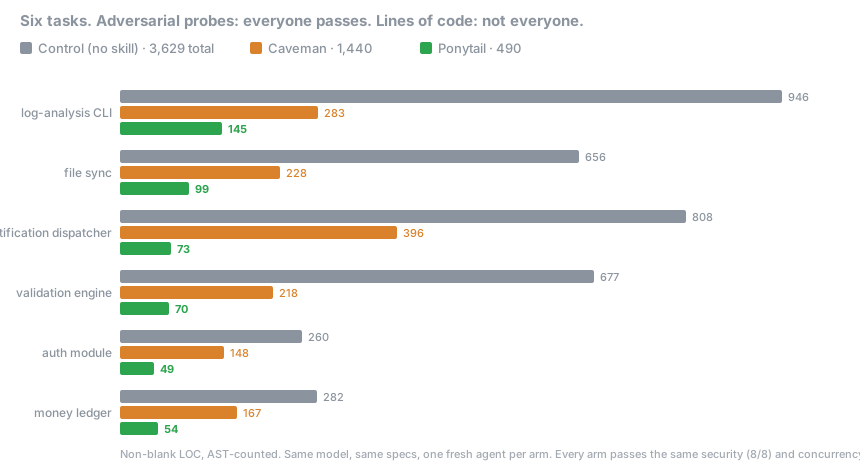
Six tasks: streaming log parser, atomic file sync, notification dispatcher, validation engine, auth module, concurrent money ledger. One spec each, one fresh agent per arm, same model. Three arms: no skill, the [caveman](https://github.com/JuliusBrussee/caveman) skill, and ponytail. Every arm passes the same adversarial security and concurrency probes. Then the agreement ends:
**47% fewer tokens than the no-skill agent. 3× faster. A seventh of the code.** The 3,139 lines nobody wrote have never caused an incident. When a surprise feature request hit two of the tasks, ponytail extended in 96 changed lines; caveman needed 413, the no-skill agent 1,115. Every shortcut ponytail took is marked in the code with a `ponytail:` comment naming its upgrade path. Data: [benchmarks/](benchmarks/).
## How it works
Before writing code, the agent stops at the first rung that holds:
```
1. Does this need to exist? → no: skip it (YAGNI)
2. Stdlib does it? → use it
3. Native platform feature? → use it
4. Installed dependency? → use it
5. One line? → one line
6. Only then: the minimum that works
```
Lazy, not negligent: trust-boundary validation, data-loss handling, security, and accessibility are never on the chopping block.
## Install
The most effort ponytail will ever ask of you:
### Claude Code
```
/plugin marketplace add DietrichGebert/ponytail
/plugin install ponytail@ponytail
```
### Codex
```bash
codex plugin marketplace add DietrichGebert/ponytail
codex
```
Open `/plugins`, select the Ponytail marketplace, and install Ponytail. Then
open `/hooks`, review and trust its two lifecycle hooks, and start a new thread.
### Pi agent harness
```
pi install git:github.com/DietrichGebert/ponytail
```
### OpenCode
Run OpenCode from a checkout of this repo (the plugin reuses its `hooks/` and `skills/`), and add to `opencode.json`:
```json
{ "plugin": ["./.opencode/plugins/ponytail.mjs"] }
```
Injects the ruleset every turn at the active level; adds `/ponytail` and `/ponytail-review`. OpenCode also auto-loads this repo's `AGENTS.md`, so the rules hold even without the plugin — the plugin adds the `lite/full/ultra/off` levels.
That was it. He'd be proud. He won't say it.
Active every session. `/ponytail-review` finds what to delete in your diff. `/ponytail ultra` exists for when the codebase has wronged you personally. `/ponytail-help` explains the rest.
In Codex, invoke the skills as `@ponytail`, `@ponytail-review`, and
`@ponytail-help`. Startup and mode-change text shows the current mode.
Cursor, Windsurf, Cline, Copilot, Aider, Kiro: copy the matching rules file from this repo ([`.cursor/rules/`](.cursor/rules/), [`.windsurf/rules/`](.windsurf/rules/), [`.clinerules/`](.clinerules/), [`.github/copilot-instructions.md`](.github/copilot-instructions.md), [`AGENTS.md`](AGENTS.md), [`.kiro/steering/`](.kiro/steering/)).
Kiro: copy `.kiro/steering/ponytail.md` to `~/.kiro/steering/` (global) or `.kiro/steering/` in your project.
Which files map to which agent: [Agent portability](docs/agent-portability.md).
## Development
When changing the compact rule text, keep the agent copies aligned:
```bash
node scripts/check-rule-copies.js
```
## FAQ
**Does it need a config file?**
No.
**What if I really need the 120-line cache class?**
You don't. Insist anyway and he'll build it. Slowly. Correctly. While looking at you.
**Does it scale?**
The code you never wrote scales infinitely. Zero bugs, zero CVEs, 100% uptime since forever.
**Why "ponytail"?**
You know exactly why.
## License
[MIT](LICENSE). The shortest license that works.